
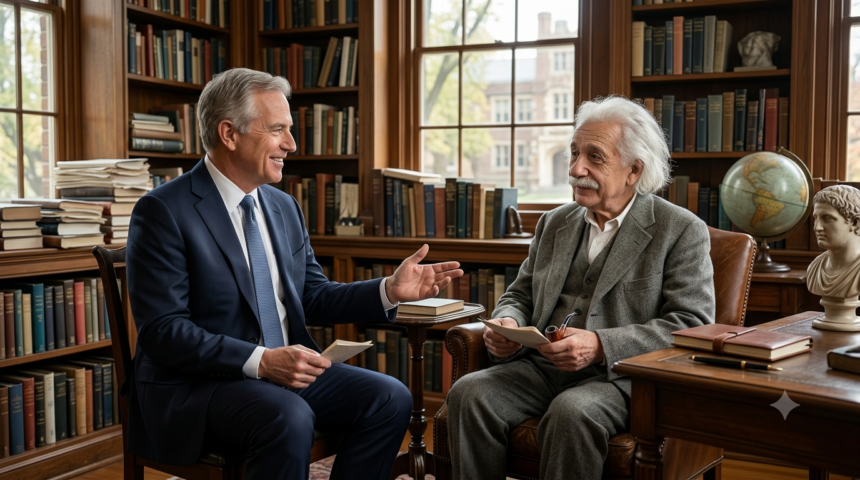
What connects a modern Wall Street real estate billionaire with the most iconic physicist in human history? At first glance, John Grayken and Albert Einstein belong to completely different universes. One built a multi-billion-dollar private equity empire away from the public eye, while the other reshaped our fundamental understanding of time, space, and the cosmos.
- 1. Who is John Grayken? The Silent Titan of Modern Real Estate
- 2. Who is Albert Einstein? The Visionary Who Changed Physics
- 3. John Grayken and Albert Einstein: Unexpected Mindset Connections
- 1. Contrarian Thinking & First Principles
- 2. Deep Focus and Privacy
- 3. Pattern Recognition in Complex Systems
- 4. Key Differences: High Finance vs. Theoretical Science
- 5. Lessons from the Lives of John Grayken and Albert Einstein
- Conclusion: The Shared Spirit of Mastermind Strategy
- Frequently Asked Questions (FAQs)
However, when you analyze John Grayken and Albert Einstein side-by-side, surprising parallels emerge in their strategic thinking, approach to risk, personal privacy, and legacy creation. Comparing John Grayken and Albert Einstein offers a fascinating perspective on how masterminds in finance and science navigate complex systems to achieve extraordinary success.
1. Who is John Grayken? The Silent Titan of Modern Real Estate
John Grayken is an American-born billionaire investor and the founder of Lone Star Funds, one of the world’s largest private equity firms specializing in distressed real estate and financial assets.
The Rise of Lone Star Funds
Born in 1956, Grayken studied at the University of Pennsylvania and earned his MBA from Harvard Business School. After working with Morgan Stanley and legendary investor Robert Bass, he launched Lone Star Funds in 1995.
- Investment Philosophy: Purchasing undervalued, distressed assets during economic crises.
- Global Footprint: Massive investments across North America, Europe, and Asia.
- Mastery of Risk: Identifying value where others see chaos and financial ruin.
A Masterclass in Low-Profile Success
Unlike high-profile venture capitalists, John Grayken intentionally keeps a low public profile. By renouncing his US citizenship in the late 1990s and becoming an Irish citizen, he positioned his operations globally, focusing entirely on long-term strategy rather than media spotlight.
2. Who is Albert Einstein? The Visionary Who Changed Physics
Albert Einstein (1879–1955) needs little introduction. As the theoretical physicist who developed the Theory of General Relativity, his name has become synonymous with human genius.
Redefining the Nature of Reality
Einstein revolutionized modern physics through his groundbreaking discoveries:
- Special Relativity (1905): Proved that space and time are linked for objects moving at a constant speed.
- Mass-Energy Equivalence ($E=mc^2$): Demonstrated that mass and energy are interchangeable.
- General Relativity (1915): Re-imagined gravity not as a force, but as the curvature of spacetime.
Einstein’s intellectual bravery challenged centuries of scientific consensus established by Sir Isaac Newton, forever changing technology, astronomy, and modern thought.
3. John Grayken and Albert Einstein: Unexpected Mindset Connections
While their fields are vast distances apart, examining John Grayken and Albert Einstein reveals core mental habits shared by elite thinkers across disciplines.
       CORE PHILOSOPHY MATRIX
┌──────────────────────────────────────┐
│       John Grayken                   │
│       - Value in Financial Chaos     │
│       - Risk Mitigation              │
│       - Operational Efficiency       │
├──────────────────────────────────────┤
│       Albert Einstein                │
│       - Clarity in Cosmic Complexity │
│       - Thought Experiments          │
│       - Theoretical Innovation       │
└──────────────────────────────────────┘
1. Contrarian Thinking & First Principles
Both men rejected mainstream consensus:
- Einstein questioned fundamental assumptions about absolute time and space when conventional physics reached a dead end.
- Grayken aggressively buys assets during market panic when traditional investors are selling in fear.
2. Deep Focus and Privacy
Neither figure let public opinion dictate their path. Einstein spent decades in quiet contemplation at Princeton’s Institute for Advanced Study, while Grayken constructed one of the most profitable private funds globally without seeking celebrity status.
3. Pattern Recognition in Complex Systems
Financial markets and theoretical physics are both complex, dynamic systems. Finding signals within noise is a defining trait seen when comparing John Grayken and Albert Einstein. Einstein decoded quantum and cosmic patterns; Grayken decodes global economic cycles and credit distress.
4. Key Differences: High Finance vs. Theoretical Science
Despite intriguing analytical comparisons between John Grayken and Albert Einstein, their operational objectives diverge significantly.
| Feature | John Grayken | Albert Einstein |
| Primary Field | Private Equity & Real Estate | Theoretical Physics |
| Core Benchmark | ROI & Risk-Adjusted Returns | Empirical Truth & Universal Laws |
| Primary Tool | Financial Capital & Restructuring | Mathematical Equations & Thought Experiments |
| Public Visibility | Retrospective & Private | World-Renowned Cultural Icon |
While Einstein pursued universal physical truths that apply across light-years, Grayken focuses on pragmatic capital deployment within human financial institutions.
5. Lessons from the Lives of John Grayken and Albert Einstein
Studying John Grayken and Albert Einstein provides timeless insights for entrepreneurs, researchers, and strategic leaders:
- Embrace Unpopularity: True breakthroughs require standing alone when market or scientific consensus disagrees with your data.
- Master Risk & Uncertainty: Whether calculating financial downside or subatomic probabilities, success requires measuring risk accurately.
- Focus on Core Fundamentals: Strip away unnecessary noise to concentrate purely on primary mechanics.
Conclusion: The Shared Spirit of Mastermind Strategy
Comparing John Grayken and Albert Einstein highlights an essential truth: high achievement in any domain—be it quantum mechanics or private equity—relies on disciplined thinking, contrarian courage, and deep system analysis.
While Albert Einstein unlocked the secrets of the cosmos and John Grayken mastered the mechanics of global markets, both figures demonstrate the incredible impact of dedication to one’s craft. Studying the legacies of John Grayken and Albert Einstein reminds us that innovation and success belong to those who see opportunities where others see only complexity.
Frequently Asked Questions (FAQs)
Did John Grayken and Albert Einstein ever interact?
No. Albert Einstein passed away in 1955, while John Grayken was born in 1956. The comparison between John Grayken and Albert Einstein is an analytical look at strategic mindsets in finance versus theoretical physics.
What is John Grayken best known for?
John Grayken is best known as the founder and chairman of Lone Star Funds, a globally recognized private equity firm specializing in real estate and distressed asset management.
What was Albert Einstein’s most famous discovery?
Albert Einstein is most famous for his Theory of Relativity and the world-renowned equation $E=mc^2$, which explains the relationship between mass and energy.
What core lesson can we learn from John Grayken and Albert Einstein?
The primary lesson from studying John Grayken and Albert Einstein is the power of independent, first-principles thinking—evaluating raw data objectively rather than following popular trends or consensus.
